Multimodal Parkinson's Detection Screening System
Developed an attention-based multimodal model combining voice acoustics (UCI) and gait VGRF signals (PhysioNet) for early Parkinson’s detection.
Research Paper
AI in healthcare
Interactive Demos

Project Overview
GitHub Repo | Live Demo
Under Review | IEEE
Focus Areas
Multimodal Learning · Healthcare AI · Biomedical Signal Analysis · Explainable Deep Learning · Real-Time Inference Systems
Built a multimodal Parkinson’s disease screening system that combines voice acoustics and gait VGRF signals for early-stage neurological assessment. Existing approaches relied heavily on single-modality predictions, limiting robustness and clinical reliability, so I designed an attention-based fusion framework capable of learning cross-modal diagnostic patterns while improving interpretability and real-time usability.

System Architecture
Developed an end-to-end multimodal deep learning pipeline integrating biomedical signal processing, attention-based fusion learning, and real-time inference for AI-assisted Parkinson’s disease screening. The system combines heterogeneous physiological signals to improve diagnostic robustness, interpretability, and deployment usability.
Key Contributions
Designed an attention-based multimodal fusion architecture combining voice acoustic biomarkers (UCI Parkinson’s Dataset) and gait VGRF signals (PhysioNet)
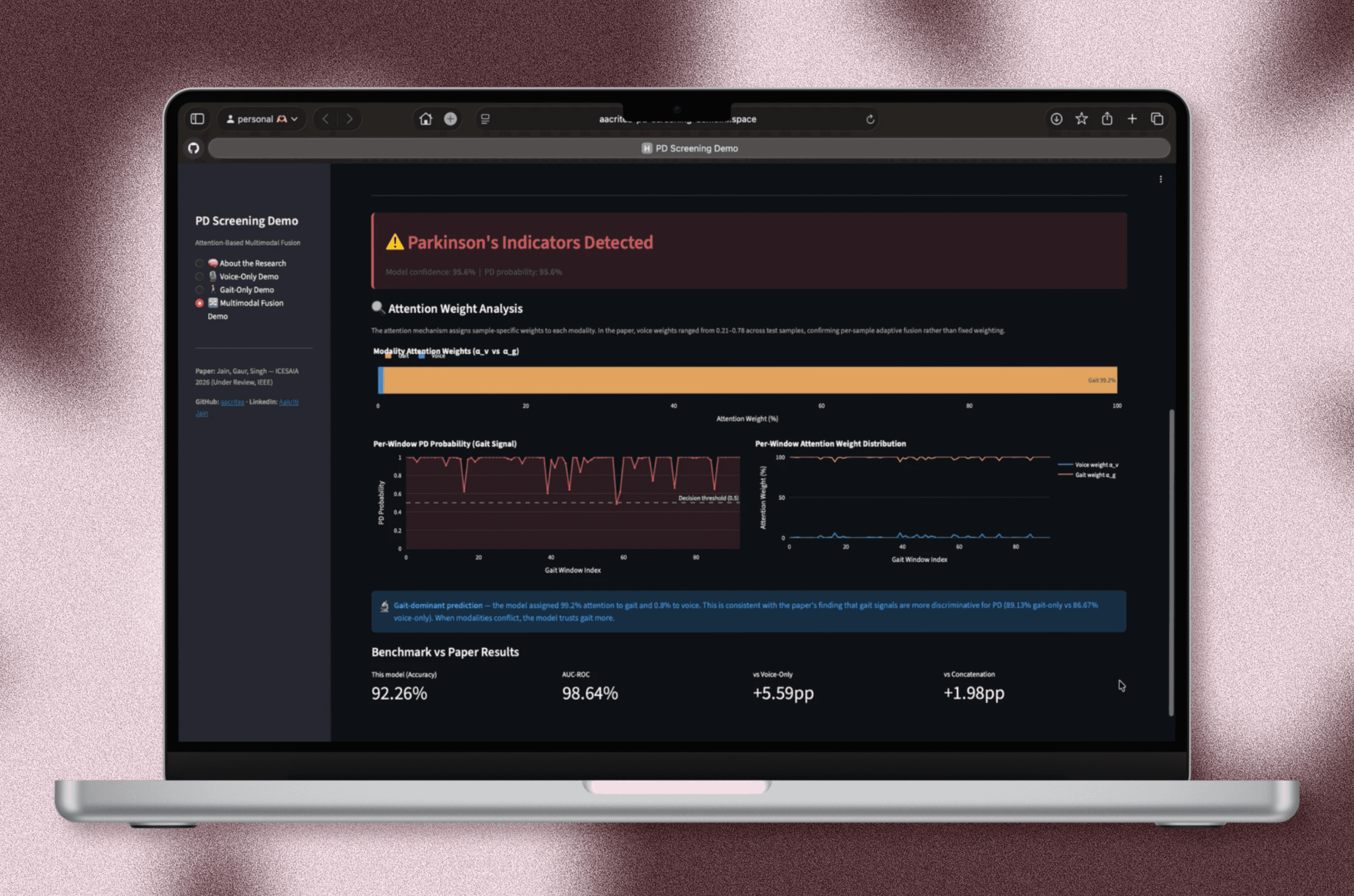
Achieved 92.26% classification accuracy and 0.986 AUC-ROC on subject-wise unseen evaluation data
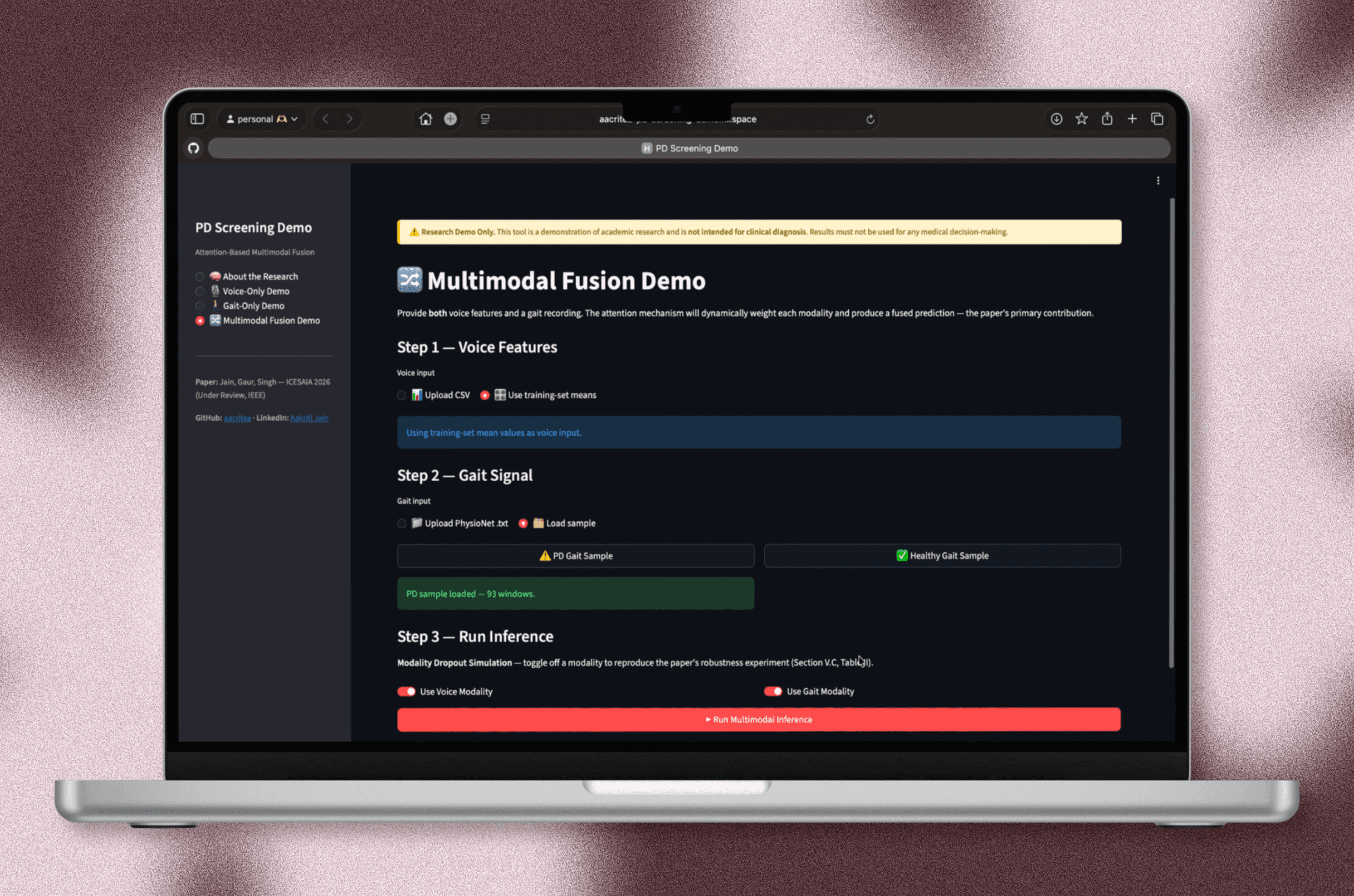
Built and deployed a real-time Streamlit application with live predictions and attention-weight visualization
Implemented modality contribution scoring and modality dropout analysis for interpretability, robustness validation, and failure-case analysis
Optimized the inference pipeline for lightweight deployment and interactive healthcare demonstrations
Developed explainable prediction interfaces visualizing confidence scores, modality weighting, and multimodal diagnostic behavior in real time
Outcome
The project demonstrates how multimodal deep learning can significantly improve early Parkinson’s screening compared to unimodal diagnostic systems. By combining heterogeneous biomedical signals with attention-driven fusion, the system improves robustness, interpretability, and accessibility for AI-assisted neurological screening workflows.
Tech Stack
PyTorch · Streamlit · Hugging Face Spaces · Python · Attention Mechanisms · Biomedical Signal Processing · Multimodal Learning · Explainable AI · Deep Learning